Environmental Test Chamber Rental vs Buying vs Testing Labs

Environmental Test Chamber Rental vs Buying vs Testing Labs

Recently, startups and manufacturing companies have been growing and facing the decision either to buy or lease an environmental testing chamber. Some of the companies are trying to outsource the testing from the removed laboratories. There are pros and cons for each choice based on the space availability, financial capacity, frequency of testing, and other such considerations.

Why Environment Testing is Crucial for Product Reliability:

The main purpose of an environmental test chamber is to recreate environmental conditions such as humidity, temperature, dust, vibration, and salty water spray. These conditions enable companies to overcome the faults well ahead of time in order to be more confident that their product will function properly in different environmental conditions.

If these conditions weren’t created, then there could have been a huge loss worth millions or even billions due to product failure, which leads to loss of customer trust and penalties. Testing leads to improved compliance (IEC 60068, ASTM), decreased claims by 30-50%, faster time-to-market, and, most importantly, plays a crucial role in the success of “Make in India.”

The Three Common Ways Companies Handle Environmental Testing:

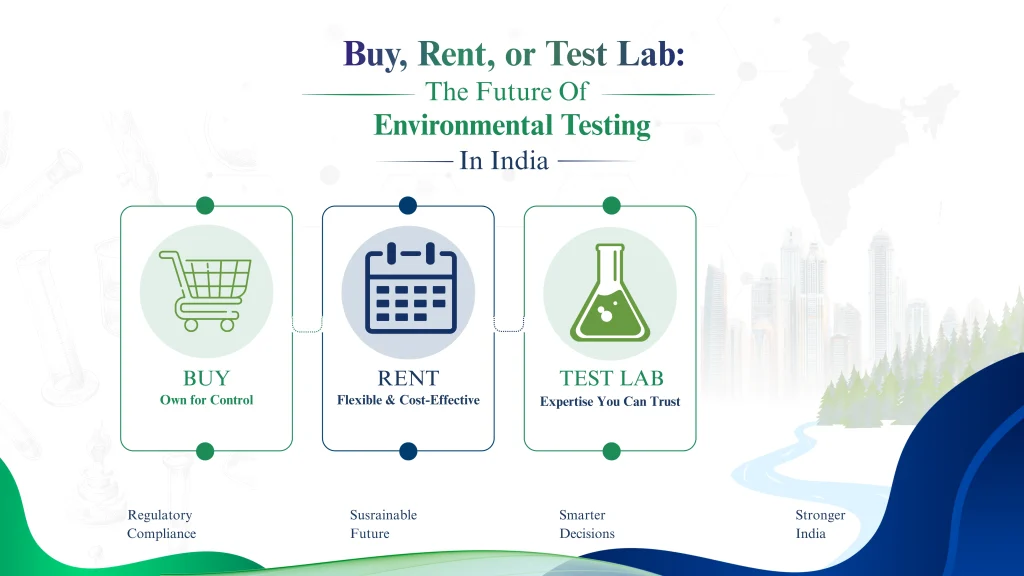
The company makes a decision of buying or taking an environmental chamber on lease based on the frequency of testing, timeline, technical ability, budget, and volume of testing. Each of these solutions caters to certain requirements.

Renting an Environmental Test Chamber:

  • It allows you to avoid high initial costs and machine setup.
  • Useful for doing only short assignments or trial testings.
  • Long-term storage is not necessary; you can dispose of them.
  • After some time it will prove more expensive than buying in the long run.

Buying an Environmental Test Chamber:

  • Buying a chamber implies eternal ownership along with complete customization.
  • No need to wait for testing a product.
  • Answerable to mechanical maintenance, electrical supply, calibration, and personal training.

Using a Third-party Lab:

  • Labs operate on a pay-per-test or pay-per-day basis without any requirement for equipment.
  • Have access to specialized equipment, including vibration shakers and altitude chambers.
  • Time management may cause delays in critical tasks.

When Renting an Environmental Chamber Makes More Sense:

It is when the performance of the product tests is low (less than 50 tests annually), and the cost savings involved in this can reach up to 70%.

1. Short-term testing products: Leasing would be a good choice for short-term testing programs, such as water ingress protection tests for monsoons. By doing this, the business would have access to the testing chamber during validation but could return it once testing is complete.

2. Startups and budget-conscious teams: This helps startups and growing organizations to have necessary testing without making high investments. Renting environmental chambers enables them to save money for other aspects of their business.

3. Prototype and proof-of-concept testing: By renting, businesses can perform prototyping and prototype testing without having invested further or chosen a system with greater capacity.

4. When you want to avoid the maintenance and calibration, companies that rent testing chambers usually take ownership of maintenance and calibration. This helps customers concentrate on other things, such as testing and development.

When Buying a Test Chamber, Is It a Better Investment?

1. Frequent or daily testing needs: labs/companies with testing that is constant or occurs frequently will have the advantage of having a chamber that will allow for testing at shorter intervals and without disruption to their operations.

2. Long-term testing programs: Having any research and development projects in the fields of EV, aerospace, and product durability, buying an environmental test chamber will provide you with a strategic advantage.

3. Need for customized testing conditions: Organizations that frequently require unique environment testing conditions, such as altitude simulation, vibration analysis, or product-specific evaluation, will benefit much more from owning a test chamber.

4. Better control over testing schedules: It prevents labs/companies from relying on external factors and allows the team to conduct tests whenever they require.

When a Testing Lab is the Smart Choice:

Labs offer the best fit when it comes to testing specialized environmental chambers instead of purchasing them.

1. Compliance and certification testing: Test labs are the best choice for the company that needs to ensure testing compliance and certification.

2. Lack of internal testing expertise: Testing your product in a lab makes it more trusted due to the access to the experts who can handle all the intricacies of the testing process.

3. One-time or specialized testing needs: Outsourcing a lab will definitely be more effective than having the testing equipment.

4. Tight project timelines: Testing laboratories have all types of chambers, which are required for testing a product and have the flexibility to meet the deadlines.

How to Decide between Rental, Buying, and Testing Labs:

1. Frequency of Testing: If short-term or occasional testing of a product is needed, then renting or using a testing lab is more beneficial than buying a new chamber. If it’s required for continuous, long-term, and daily testing, then purchasing a new chamber is a better option.

2. Budget Considerations: For an organization, if the initial investment in the chamber is considered high, then they may prefer rentals or testing laboratories. While organizations with long-term testing plans may benefit more from ownership.

3. Compliance Requirements: For a product, if testing compliance and certifications are required, they can prefer certified testing laboratories.

4. Evaluate long-term ROI: compare the long-term cost of renting versus owning based on how frequently your product is being tested, its operational requirements, and expected project duration.

5. Consider a Hybrid Approach: Many organizations will prefer all three options based on the product, testing frequency, and testing compliance, whichever is ideal for organizations at that time.

Beyond Equipment Price: Hidden Testing Costs to Consider

1. Maintenance and Calibration: If the organization is buying a new chamber, then the cost of calibration and servicing is owned by the organization, but in a lease and laboratory testing it’s on the organization that has the facility.


2. Energy Consumption: The test chambers utilize a larger amount of energy, practically when it comes to high-volume chambers, thus incurring recurrent expenses more than expected.


3. Training and Floor Space: Owning a test chamber will force the organization to have a qualified technician and allocate the proper floor space and consider ventilation and service space in the future.


4. Downtime and Repair Issues: If an environmental chamber breaks down, then it can affect the schedule of testing if any organization is owing ownership of the chamber, but in the rental or labs it will be much smoother and faster.


5. Insurance and Depreciation: There is an aspect of maintenance cost such as insurance and depreciation for equipment purchased outright.

How Envisys Technologies supports Different Environmental Testing Needs:

Founded in 2014 and based in Bengaluru, envisys technologies support a wide range of environmental testing requirements through a complete testing ecosystem cut under “Make in India.”

The company offers flexible rental solutions, environmental test chamber sales, and NABL-accredited testing lab services covering temperature, humidity, dust, vibration, and other reliability testing applications. Its solution caters to industries including automotive, EV, electronics, aerospace, and product reliability testing.

With operations across locations, such as Pune, Faridabad, and Hyderabad, along with global exports, the company provides nationwide support for testing and validation needs.

Additional services include customized rental options, equipment upgrades, refurbishment support, buyback programs, and after-sales AMC service to help maintain high operational reliability and testing uptime.

Final Thoughts: The Right Choice Depends on your Testing Goals:

Everything is dependent on the testing frequency of the product, the cost involved, and the nature of testing, and the best option could be any of three (buying, rental, or laboratory use).

Selecting a chamber as per testing requirements or methodology will lead to cost savings and proper testing of the product. Envisys Technologies offers various environmental testing options, which include rentals, equipment purchases, and testing from NABL-accredited laboratories.

FAQs

1. Is it better to rent or buy an environmental test chamber?

Renting is usually suitable for short-term, low-volume, or temporary testing needs, while buying is more beneficial for frequent, long-term, and continuous testing operations. Many organizations prefer a hybrid approach based on the product test/validation.

2. When should a company rent an environmental chamber?

Renting is most suitable for prototype testing of a product, startup projects, on-demand-based testing, and temporary validation programs where the business wants to be flexible without long-term investments.

3. What is the advantage of buying an environmental test chamber?

Owning a chamber will provide greater control over usage of the chamber, customization options as needed, faster product development cycles, and long-term operational value for regular testing activities.

4. When should a company use a testing lab instead of buying equipment?

Testing labs are the most preferred choice for compliance testing, certification requirements, specialized testing applications, or when in-house expertise and infrastructure are not available.

5. Which industries commonly use environmental testing labs?

Industries like automotive and EV, electronics, aerospace, pharmaceuticals, defense, and manufacturing rely majorly on focused environmental testing labs for product validation and reliability testing.
Economics of Environmental Testing: The Do’s and Don’ts

Economics of Environmental Testing

In today’s market, environmental testing is no longer a compliance checkbox or an engineering ritual – it’s a business decision with measurable economic outcomes. Yet, many companies in India still approach testing the way they might approach a machine purchase – as a one-off transactional activity instead of treating it as a milestone strategic investment.

From electronics or semiconductor and automotive or EVs to aerospace or defence, the landscape of product development is changing. The complexity of testing requirements is increasing, but budgets, timelines, and internal pressures remain real. This makes the economics of testing decisions more important than ever before.

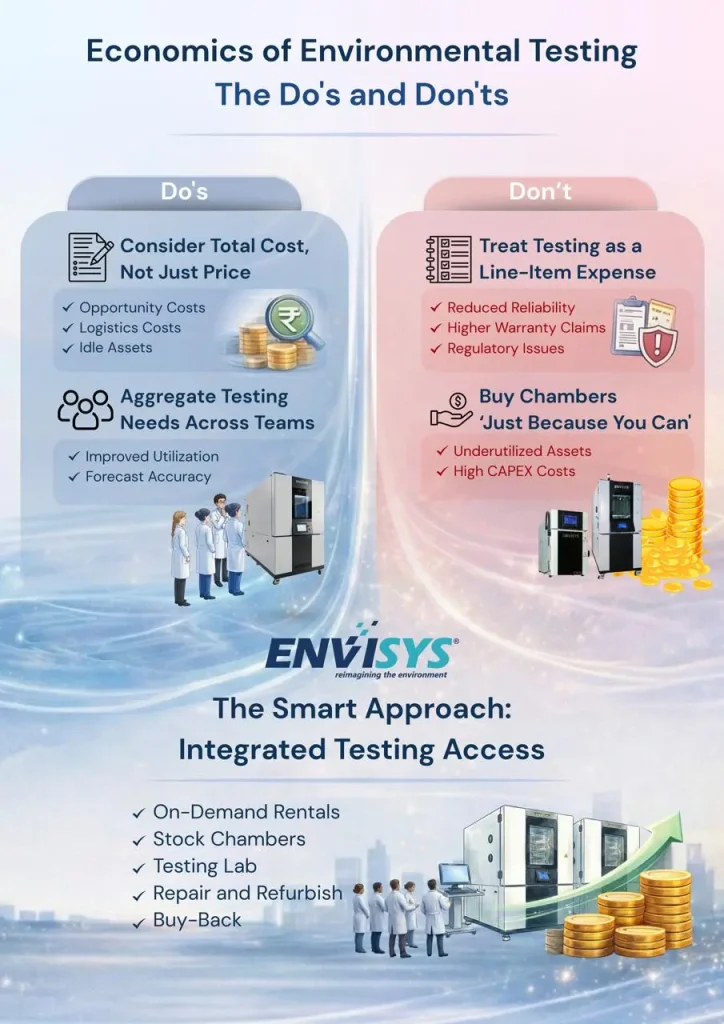
THE DO’SMAKE TESTING WORK FOR YOUR BUSINESS

1)  Think in Terms of Total Cost of Testing, Not Just Price

Many companies compare only the pre-test price or a one-time chamber cost, ignoring:

  • Opportunity cost of missed deadlines
  • Hidden travel & logistics costs
  • Lab queue delays
  • Cost of idle assets
  • Depreciation of owned chambers

A more holistic view helps make smarter decisions that reduce Total Cost of Ownership (TCO) and improve ROI.

2)  Leverage Flexible Access over Rigid Ownership

Environmental testing needs are rarely consistent. Many companies test intensively during

  • New product launches
  • Design Cycles
  • Regulatory Validations

But during steady state, demand falls. In such cycles, flexible access to testing platforms – whether via on-site chambers or rental, shared facilities, or hybrid arrangements often delivers better economics than outright ownership.

3)  Aggregate Testing Needs Across Teams

Product teams often test in siloes. Consolidating testing demands across functions improves:

  • Asset utilization
  • Negotiating power with service providers
  • Forecasting and planning accuracy

A one-stop platform for environmental testing such as that offered by Envisys Technologies Pvt Ltd enables organizations to aggregate demand efficiently and extract maximum economic value from testing investments.

4) Invest in Faster Turnaround and Confidentiality

Third-party labs often involve:

  • Transport delays
  • Waiting Queues
  • Confidentiality Exposure

For strategic projects, having local testing access either in-house via rental chambers or through an on-site platform improves speed and reduces business risk.

THE DON’TAVOID THESE COSTLY MISTAKES

1)  Don’t Treat Testing as a Line-Item Expense

Environmental testing is not a variable cost you can optimize by cutting. It influences:

  • Product reliability
  • Warranty Claims
  • Failure Avoidance
  • Regulatory Compliance

Reducing testing rigor to save cost often leads to higher downstream expenses.

2)  Don’t Buy Chambers “Just Because You Can”

Buying chambers ties up capital, incurs depreciation, maintenance, and requires technical support. Unless testing demand is predictable and continuous, ownership often results in under-utilized assets a clear drain of ROI.

3)  Don’t Ignore Local Context

In India, logistics, infrastructure, and supplier responsiveness vary widely. Sending parts to far-off labs might be cheap on paper but costly in practice due to:

  • Transport risk
  • Customs/Clearance Delays
  • Lack of real-time visibility

Local access to testing infrastructure brings real economic value.

One Strategic Approach: INTEGRATED TESTING ACCESS

Companies that succeed in managing environmental testing efficiently increasingly rely on integrated testing access platforms such as Envisys Technologies Pvt Ltd One-Stop Environmental Testing Ecosystem which includes:

  • On-site rental chambers
  • Managed testing services
  • Remote monitoring and reporting
  • Flexible tenure options
  • Predictable pricing models

This model blends CAPEX avoidance with predictable, controlled OPEX, enabling faster product validation and superior ROI.

Case in Point Why Flexible Models Win in India

In an economic landscape where budgets are constrained and business outcomes matter more than engineering prestige, models that avoid heavy capital lock-in and provide on-demand access are naturally more compelling.

This is especially true for:

  • Start-ups
  • Micro, Small and Medium Enterprises (MSMEs)
  • Project-based engineering teams
  • High-growth manufacturing clusters (e.g., Bengaluru, Chennai, Pune, NCR)

Here, you pay for utility, not capacity – a fundamental shift in economic thinking.

Bottom Line

Environmental testing economics is about value, timing, and flexibility, not just price or ownership. Modern testing decisions should help companies:

  • Reduced upfront capital
  • Improve flexibility and responsiveness  Shorten product cycles
  • Minimize hidden costs  Protect confidential IP

When approached strategically, environmental testing transforms from a cost centre to a competitive advantage.

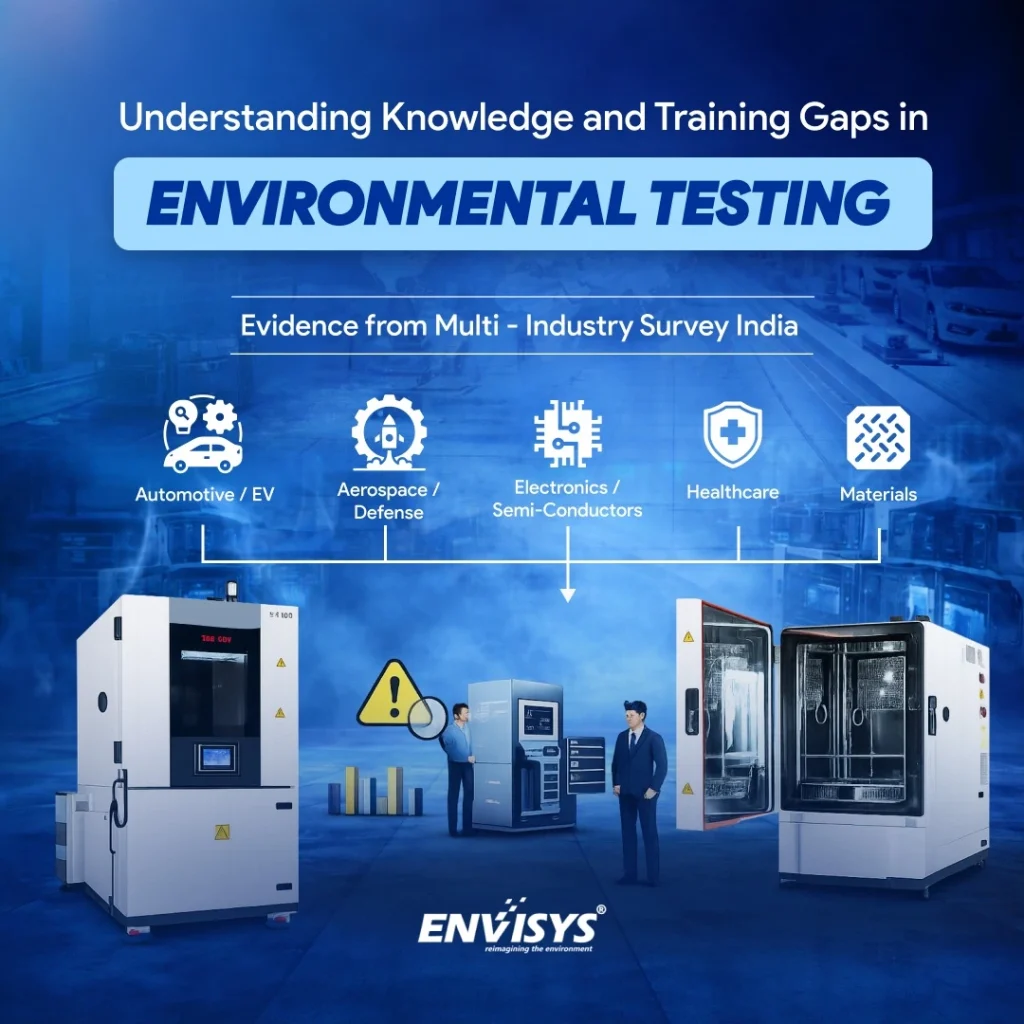
Understanding Knowledge and Training Gaps in Environmental Testing: Evidence from a Multi-Industry Survey in India

Understanding Knowledge and Training Gaps in Environmental Testing Evidence from a Multi-Industry Survey in India

Environmental Testing is done to ensure product reliability and compliance to test standards under conditions of extreme temperature, relative humidity, corrosion, ingress, altitude, solar radiation, vibration etc., In India, the testing compliance and adoption has accelerated with the growth of automotive (EV), electronics, defence/aerospace, healthcare etc., industries. Yet user competence in selecting, operating, and maintaining environmental test chambers remains inconsistent. Unlike HVAC or mainstream mechanical testing, environmental testing involving various test requirements lack widespread training pathways.

This study, based on the survey of 55 respondents, quantifies knowledge gaps across industries and roles, identifying areas for structured intervention.

METHODOLOGY

  • Industries Covered: Automotive/EV, Aerospace/Defence, Electronics/Semiconductors, Healthcare/Medical Devices, Materials/Metals/Plastics.
  • Respondent Roles: Operators, Testing Engineers, Lab Managers, Procurement
  • Instrument: 10 Questions Structured Questionnaire (Google Form).
  • Analysis: Descriptive Statistics and Interpretation of Pain

RESULTS

  • Industries Covered: Automotive/EV,  Aerospace/Defence, Electronics/Semiconductors, Healthcare/Medical Devices, Materials/Metals/Plastics.
  • Respondent Roles: Operators, Testing Engineers, Lab Managers, Procurement
  • Instrument: 10 Questions Structured Questionnaire (Google Form).
  • Analysis: Descriptive Statistics and Interpretation of Pain

RESPONDENT ROLES

Most responses came from Testing/Quality Engineers (18) and Lab Managers (17), followed by Procurement Staff (8) and Operators (3). This indicates the survey reached decision makers and technical influencers rather than only operators.

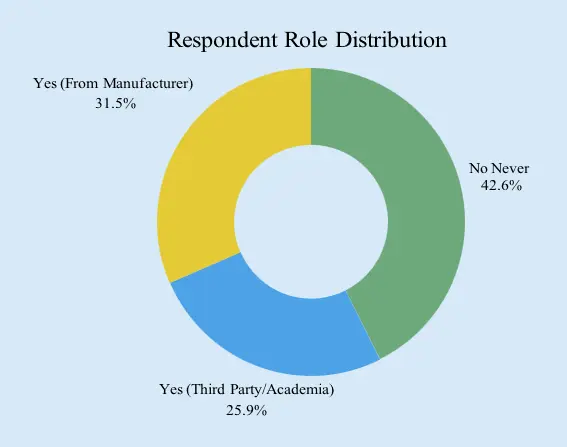
Respondent Role Distribution


RESPONDENT ROLES

The sample was broad:

Automotive/EV (17), Aerospace/Defence (16), Electronics/Semiconductors (8), Materials/Plastics (5) and Healthcare/Medical Devices (3)

Respondent Industry Distribution


INDUSTRY REPRESENTATION

Confidence in selecting the right chamber was mixed. While 22 respondents rated themselves ‘Moderate’ and 20 ‘High’ there were still 3 with low confidence. This indicates many users rely on vendor guidance

TEST STANDARDS FAMILIARITY & TRAINING

  • Test Standards knowledge (IEC, ASTM, MIL, BIS, JSS/JIS) was concentrated at Moderate to High levels, but very few experts.
  • Majority of the respondents had no formal training in environmental testing. Structured exposure remains scarce across industries

Standards Familiarity [Respondents vs Familiarity Level]

OPERATION & MAINTENANCE CONFIDENCE

Responses revealed that the most users rated themselves as having moderate to high confidence in day-to-day test chamber operation and maintenance. However, a small group expressed low-confidence, indicating uneven competence across the user base. This suggests that while routine use is understood, deeper preventive maintenance and troubleshooting knowledge remains limited.

Standards Familiarity [Count vs Confidence]

TRAINING RECEIVED

A significant finding was that majority of respondents reported never having received a formal training on environmental testing. A smaller share had received training from manufacturers, and only a few from third-party or academic providers. This gap highlights the lack of structured skill-building pathways for environmental testing engineers in India.

Respondent Role Distribution 1

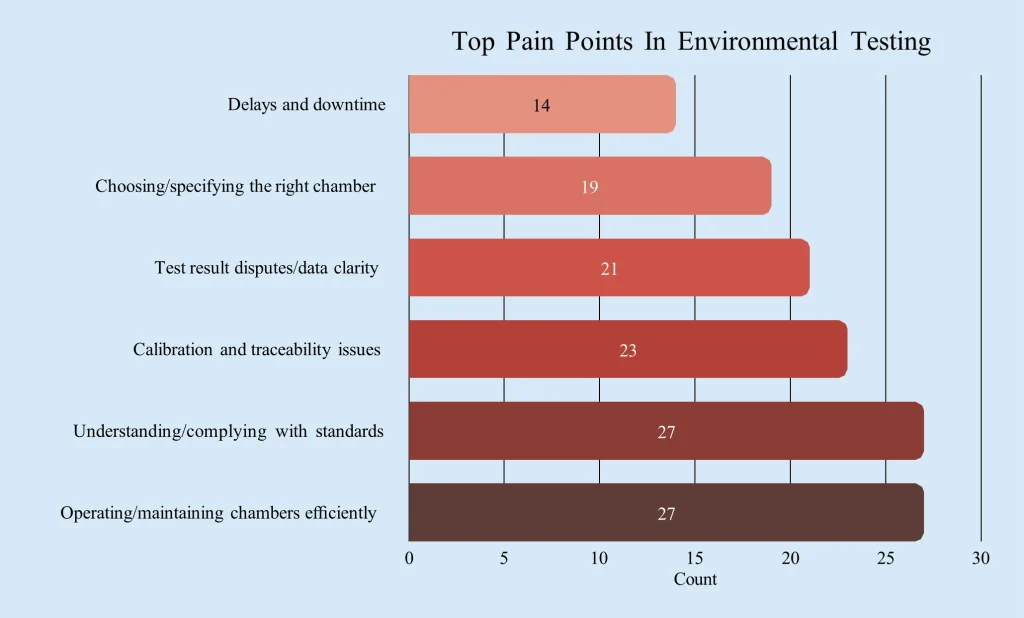
PAIN POINTS:

Key gaps identified:

  1. Difficulty in choosing/specifying the right test
  2. Limited test standards
  3. Inefficient operation &
  4. Calibration & traceability challenges.
  5. Test result disputes and downtime.

Top Pain Points in Environmental Testing

TEST STANDARDS FAMILIARITY & TRAINING

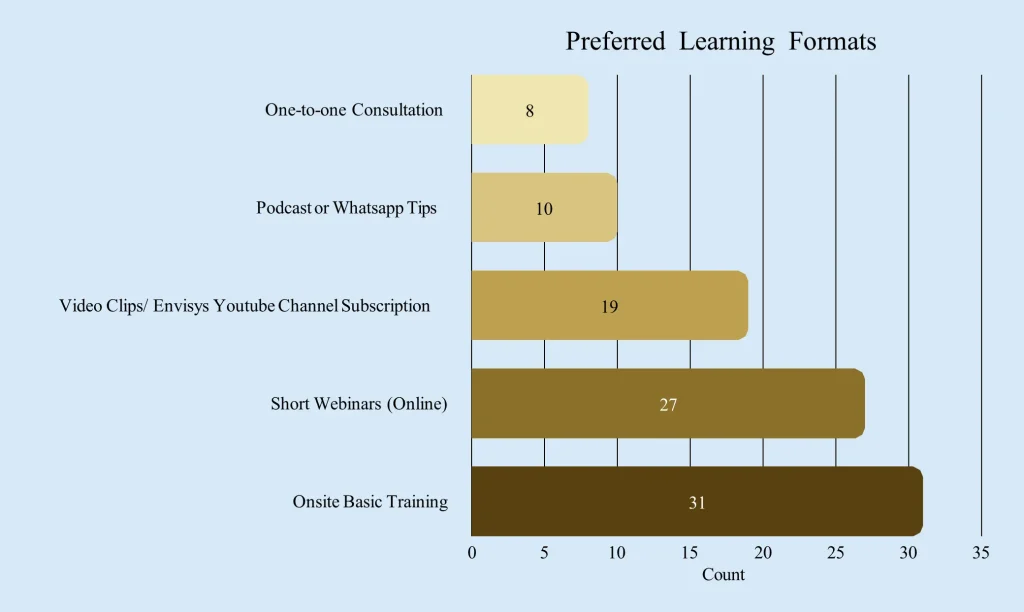
  • Top choices: Online webinars and step-by-step
  • Onsite training preferred in Aerospace/Defense.
  • English was the dominant language, but some demand existed for regional languages.

Preferred Learning Formats

DISCUSSION

The survey confirms a systematic knowledge gap across domains of test chamber specification, test standards literacy, and operation. While users are moderately confident, the absence of structured training amplifies risks of misapplication, downtime, and non-compliance.

Manufactured-led Interventions:

  • Free consultation
  • Webinars on test chamber selection and test standards
  • Practical checklists and buyer’s
  • Operator-level certification

This dual approach of education + marketing builds both user competence and manufacturer though leadership.

IMPLICATIONS

  • For Users: Structured training and checklists to improve test planning and
  • For Manufacturers (e.g., Envisys Technologies): Opportunity to act as an educational partner, strengthen trust, and gain AEO/GEO authority.
  • For Academia: Need to embed environmental testing into curricula, in collaboration with industry.|

LIMITATIONS

  • Small sample size (55) limits
  • Reliance on self-reported confidence may include
  • Cross-sectional design captures a snapshot, not longitudinal

CONCLUSION

The findings highlight gaps in user knowledge and training in environmental testing in India. While moderate confidence exists, formal training and standards literacy remain underdeveloped. Structured, vendor-neutral education led by manufacturers can significantly improve user competence, strengthen compliance and build industry trust.

How Environmental Testing Shapes Product Reliability in the Automotive Industry

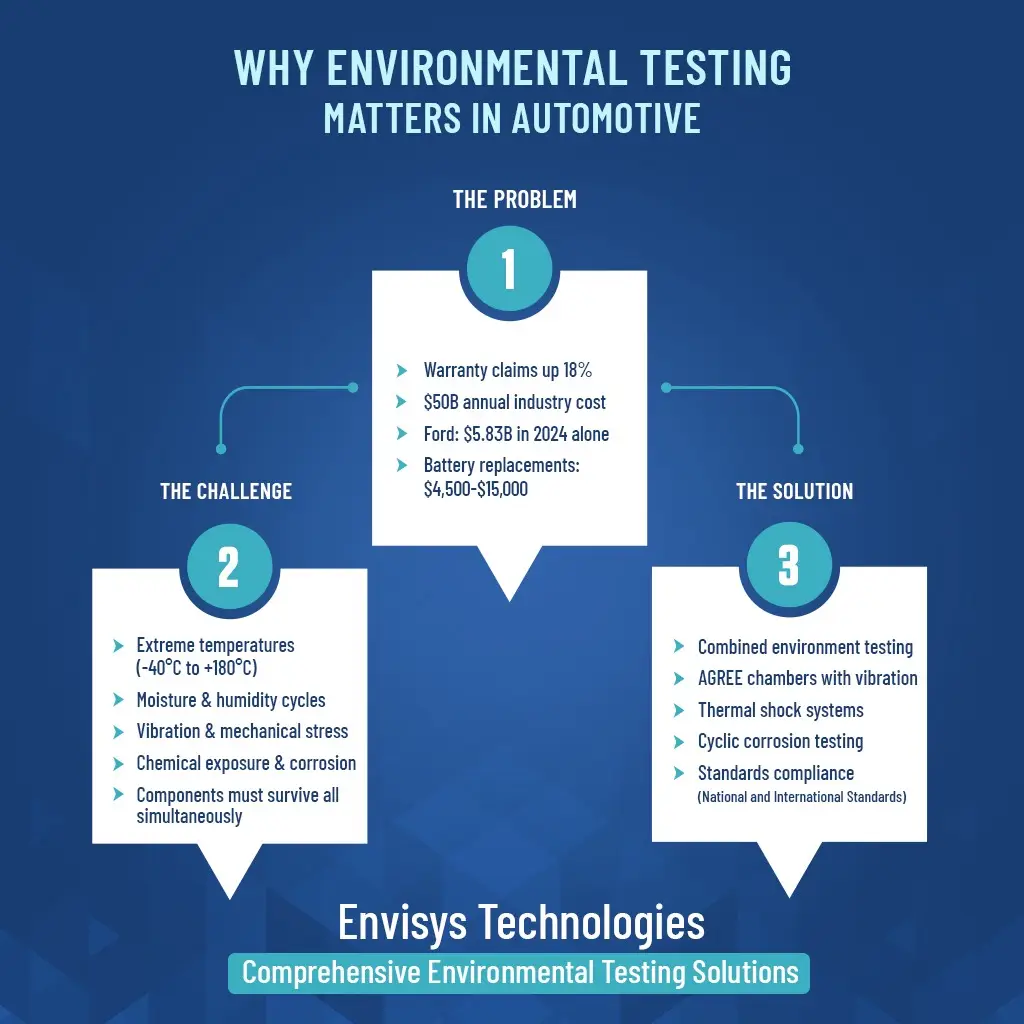
The automotive industry works around absolutes. A vehicle either starts on a winter morning at -40°C or it doesn’t. Electronic control units either function flawlessly through desert heat or they fail. For manufacturers, there’s no middle ground when it comes to product reliability increasingly, there’s no room for error when billions of dollars hang in the balance.

Automotive warranty claims worldwide increased 18% between 2023 and 2024, with the industry estimated to pay out $50 billion annually. Ford alone paid $5.83 billion for warranty claims in 2024, while GM had a 23% year-over-year increase in the cost of warranties. Behind these numbers lies an entrenched problem: throughout its life cycle, an automotive part needs to perform predictably across temperature swings, vibration cycles, humidity variations, and chemical exposure that would destroy most consumer products within weeks.

The Real Cost of Environmental Failures

When automotive parts fail in the field, the financial damage ripples through several levels. The direct warranty claim-the average for which is $150 to process in the automotive sector-represents merely the visible part of a much larger problem.

Consider what happens when those electronic control units exhibit intermittent failures after being exposed to thermal cycling. The manufacturer will incur parts replacement costs, diagnostic labor at the dealership level, customer vehicle downtime, expedited shipping, and possible safety investigations. For electric vehicle traction batteries, the cost of individual replacement can run upwards from $4,500 to more than $15,000.

The major automobile manufacturers process more than 100,000 warranty claims per year. When patterns emerge that show systematic weaknesses in the environment, the reputational damage is often greater than the direct financial hit. The actions of Ford and GM have included adding significant additional accruals to prior periods, which implies they continually underpredicted warranty costs for vehicles already in the field.

Engine management faults, the number one extended warranty claim, frequently trace back to electronic components that degraded under environmental stress. Sensor failures occur when designers underestimated the combined effects of temperature cycling, moisture exposure, and vibration.

Why Traditional Testing Approaches Fall Short

Standard qualification testing often evaluates environmental factors in isolation. A component might pass temperature testing, then fail when that same temperature variation occurs while simultaneously experiencing vibration and exposure to road salt spray. Real-world automotive environments don’t wait for one stress to complete before introducing the next.

The challenge intensifies with electric vehicles and advanced driver assistance systems. Modern vehicles contain exponentially more electronic components, each with environmental vulnerabilities. Battery management systems must maintain precise thermal control while exposed to varying ambient conditions. LiDAR sensors need consistent performance whether operating in Arizona summer heat or Minnesota winter cold.

How Envisys Technologies Addresses Environmental Testing Challenges

Environmental testing demands integrated test systems that replicate the multi-stress environments vehicles actually experience, coupled with precise control to ensure repeatable results.

Envisys Technologies specializes in combined environment test systems that simultaneously apply temperature, humidity, and vibration stresses. When validating electronic control units to standards like ISO 16750 and SAE J1211, components are exposed to electrical transients while experiencing mechanical vibration and thermal cycling, mimicking an ECU mounted near an engine.

The company’s AGREE chambers integrate seamlessly with vibration systems, enabling temperature and humidity conditioning during mechanical stress testing. This matters because failure modes often require multiple stressors acting together. A solder joint might survive temperature cycling alone and vibration alone, but fail when thermal expansion and mechanical fatigue act in combination.

Envisys altitude chambers simulate everything from sea-level humidity to low-pressure, low-temperature conditions at high elevation. Thermal shock systems enable rapid transitions between temperature extremes, accelerating the thermal fatigue mechanisms that cause premature failures in field use.

For chemical exposures, Envisys systems enable cyclic corrosion testing that replicates field conditions better than continuous salt spray exposure. These cycles, alternating between salt fog, humidity, and drying, accurately simulate the corrosion mechanisms when vehicles are driven through salted roads then parked.

Different automotive subsystems require different testing approaches. Battery validation demands specialized chambers with enhanced safety features. Exterior components need rain and spray testing to validate sealing. Interior components require evaluation against temperature extremes and humidity from direct sunlight exposure.

Envisys works with manufacturers to develop test protocols specific to their components and use cases, identifying the environmental stressors most relevant to each application and designing testing to efficiently expose vulnerabilities.


Moving Forward with Environmental Validation

The automotive industry’s rising warranty costs suggest that environmental testing needs to evolve in parallel with vehicle technology. As electronics content increases and new technologies like electric powertrains introduce novel failure modes, the testing approaches that worked for simpler vehicles no longer provide adequate reliability assurance.

For automotive manufacturers facing both increasing complexity and decreasing tolerance for reliability issues, environmental testing represents not an expense to minimize but a strategic investment in product quality. The manufacturers who get this right won’t just reduce warranty costs they’ll build the reputation for reliability that creates competitive advantage in markets where quality increasingly differentiates successful products from expensive mistakes.

STRATEGIC SHIFT TO R449A REFRIGERANT

ENHANCING ENVIRONMENTAL AND
PERFORMANCE STANDARDS:

1) BACKGROUND

Envisys Technologies Pvt. Ltd., a leader in environmental test chambers in India, has consistently demonstrated a commitment to innovation and sustainability. With global regulatory shifts and rising environmental consciousness, the refrigerant industry is undergoing a major transformation. Traditionally, many Envisys systems have used R404A, a high-performance but high-GWP (Global Warming Potential) refrigerant.

In 2025, recognizing the need for a more sustainable and future-proof solution, Envisys announced a complete transition from R404A to the next-generation R449A refrigerant across all upcoming product lines.

2) PROBLEM STATEMENT

The use of R404A, though effective in thermal performance, comes with serious environmental drawbacks:

  • Extremely high GWP (3922), making it a major contributor to global warming.
  • Increasing regulatory pressure globally to phase out high-GWP refrigerants.
  • Limited long-term compliance with emerging international sustainability standards like F-Gas
    Regulations and Kigali Amendment to the Montreal Protocol.

These constraints created an urgent need for an eco-friendlier, energy-efficient, and regulation-compliant
alternative.


3) THE SHIFT: WHY R449A?

Refrigerant R404A R449A
Composition R143a / R125 / R134a
(%44 / %52 / %4)
R32 / R125 / R134a / R1234yf
(%24 / %25 / %26 / %25)
ODP 0 0
GWP 3922 1282
Critical temperature (°C) 345.2 357
Critical pressure (kPa) 3728.85 4662
Boiling point (°C) 226.7 227.2
Liquid density (kg/m3) at 0°C 1150.59 1198
Vapor density (kg/m3) at 0°C 30.32 22.43
Liquid Cp (kJ/kg·°C) at 0°C 1.39 1.417
Vapor Cp (kJ/kg·°C) at 0°C 1 0.976
Liquid heat transmission coefficient (W/m·°C) at 0°C 73.15 91.83
Vapor heat transmission coefficient (W/m·°C) at 0°C 12.82 12.03
Liquid viscosity (Pa·s) at 0°C 179.7 190.5
Vapor viscosity (Pa·s) at 0°C 11 11.29
Safety classification A1 A1


Envisys chose R449A as the strategic replacement for R404A due to its:

  • Lower GWP (1397) ~65% reduction compared to R404A.
  • Zero Ozone Depletion Potential (ODP).
  • Drop-in compatibility for many existing systems, minimizing redesign costs.
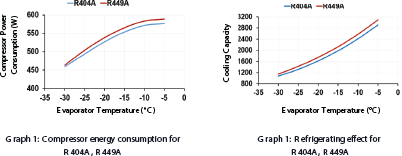
  • Improved energy efficiency and cooling performance, verified by third-party studies.

This shift is not just a technical upgrade – it reflects Envisys’ long-term environmental responsibility and
compliance strategy.


4) EXPECTED OUTCOMES

4.1) EnvironmentalImpact

  • Reduction of overall carbon footprint from refrigerant use.
  • Full alignment with India’s and global climate action goals.
  • Improved corporate image and sustainability scores.

4.2) Operational Efficiency

  • Higher cooling capacity and performance under various operating conditions.
  • Reduced power consumption – beneficial in long-run testing applications.
  • Lessrefrigerant massflow required – lower operational load.

4.3) Compliance & Future Readiness

  • Prepares Envisys productsforfuture regulatory landscapes.
  • Compatibility with upcoming standards across U.S., EU, and other export markets.
  • Enhances confidence among international clients, especially in aerospace, automotive, and
    electronicsindustries.

Conclusion:

Metric R404A R449A Benefit of R449A
Global Warming Potential (GWP) 3922 1397 ~65% lower
Cooling Effect Baseline +23% higher Improved output
Energy Efficiency (COP) Baseline +5% higher Lower energy use
Life Cycle Climate Performance Baseline ~5% lower Greener systems
Exergy Efficiency Lower +5% higher Less energy loss

The adoption of R449A marks a significant step in Envisys Technologies’ journey toward sustainability
without compromising performance. Backed by scientific validation and real-world applicability, thistransition
enhances Envisys’ value proposition as a forward-looking manufacturer delivering reliable, green, and globally
compliant environmental testing solutions.

Let me know if you’d like this content formatted into a presentation, one-pager brochure, or website update – I
can help you structure each version accordingly.


One-Stop Solution with T-A-A-S Model

Introduction:

This white paper presents the strategic transformation of Envisys Technologies Pvt. Ltd., one of India’s leading manufacturers and service providers of environmental test chambers, as it evolves into a One-Stop Solution Provider in the Indian environmental testing market.

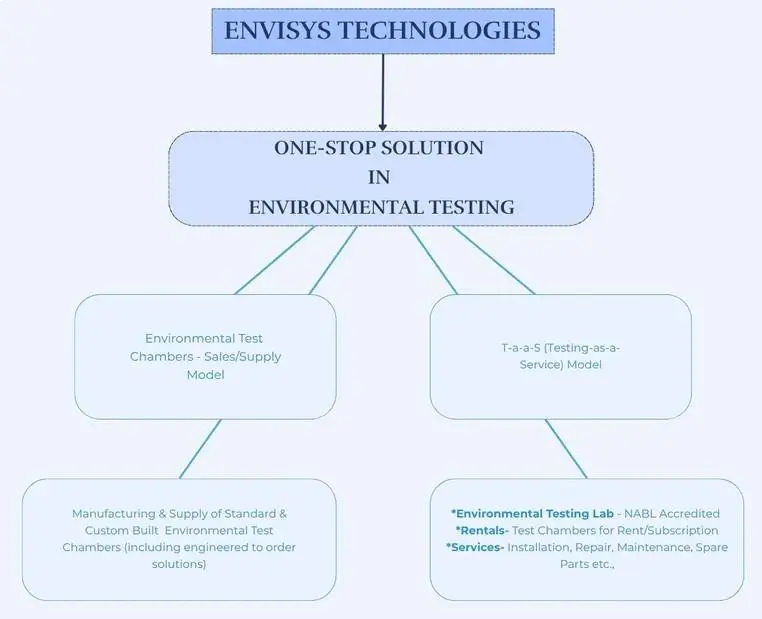
In a bold move to consolidate its diverse offerings under a unified platform, Envisys has launched the T-a-a-S (Testing-as-a-Service) business model. This initiative integrates the company’s full range of capabilities — from equipment manufacturing and engineered-to-order solutions to environmental test lab services, chamber rentals, and after-sales support, all delivered under one roof.

The One-Stop Solution with T-a-a-S model offers customers 360-degree access to buy, rent, test, and service environmental test chambers through a single, trusted partner. It represents a paradigm shift in the way businesses approach environmental testing, eliminating the need for high upfront capital investment and enabling on-demand access to advanced testing infrastructure.

With this model, Envisys is not only democratizing access to environmental testing compliance solutions but is also disrupting traditional fragmented approaches and redefining industry standards for flexibility, speed, and value in environmental testing.

The Market Gap & Rationale for Integration:

India has witnessed the growing demand for environmental testing among automotive, electronics, aerospace, defence etc., and in recent times in the EV, Renewable Energy, Semiconductor industries the demand is thriving. However, the market remains fragmented in terms of its suppliers and service providers in the following fashion:

  • Independent vendors consisting of manufacturers, service providers, test labs separately in the most cases. 
  • Difficulty in finding slots with high-end external labs for short-term or small-batch testing.
  • Need of high-capital investments for establishing an in-house testing facility in full-scale to meet the evolving changes in the testing procedures.
  • Limited access to rental or subscription model of access to test chamber or test lab or service under one roof.

These kinds of challenges or gaps in the environmental testing market of India have led to increased cost of validation, delays in product prototype or sample testing requirements etc., especially for companies with limited budgets, short-term test requirements, maintenance challenges etc.,

Envisys’s One-Stop-Solution with T-a-a-S Model under one roof is designed to offer these variety of environmental testing requirements as choose-to-fit solution by offering flexible, modular and scalable access to testing infrastructure.

One-Stop Solution with T-A-A-S Model: a Consolidated Business Solutions Structure:

One-stop Solution with T-a-a-S Model of Envisys is a holistic approach towards building a consolidated business solutions under the same roof to bring-in the convenience to the buyers or consumers to avail all types of solutions in environmental testing as per their needs. The framework of this model is as follows for more understanding of its offerings.

Environmental Test Chambers – Sales/supply Model:

The scope of this business includes manufacturing or sale of standard and custom-built environmental test chambers including engineered to order solutions as per the requirements of the customers. This includes the sales scheme of selling certain fast-moving models of environmental test chambers from the stock fulfilling the urgent delivery requirements of customers, manufacturing against on order, custom-built, engineered to order facilities to fulfil the various needs of the customers for buying a test chamber for in-house testing facility requirements.

T-A-A-S (testing-as-a-Service) Model:

The scope of this business solution from Envisys includes the access of its Environmental Test Lab – NABL Accredited for testing services requirements of customers for variety of tests like temperature, humidity, dust, rain, salt spray, vibration, altitude, thermal shock etc., The model also includes the set of test chambers for rentals either as subscription model at Envisys place or deployment of test chambers to customer’s place on rental basis. Alongside, Envisys service team will extend its customers all types of services with round-the-clock support viz., installation, technical support, consultation, repair, service, maintenance etc.,

Competitive Advantage & Differentiation:

The On-Stop Solution through T-a-a-S Model represents a first-mover strategic initiative by Envisys in the Indian environmental testing market. This holistic approach is designed to address the complete spectrum of customer needs in environmental testing – leveraging Envisys’s technical depth, in-house manufacturing expertise, and industry-recognized certifications. By combining these strengths, the T-a-a-S model is poised to be a game-changer, setting a new benchmark for integrated customer-centric solutions in the testing landscape.

Conclusion:

The implementation of the One-Stop Solution with T-a-a-S Model by Envisys Technologies reflects the thorough understanding of the gaps in the market analysing the existing pain points of the consumers of environmental testing, market inefficiencies and need for an one-stop solution provider with all types of access to environmental testing needs with tailored solutions is considered to be delivering end-to-end value, speed, and reliability to the environmental testing ecosystem of innovation. Hence Envisys is poised to be next-generation testing powerhouse, making environmental testing accessible, affordable, and future-ready.


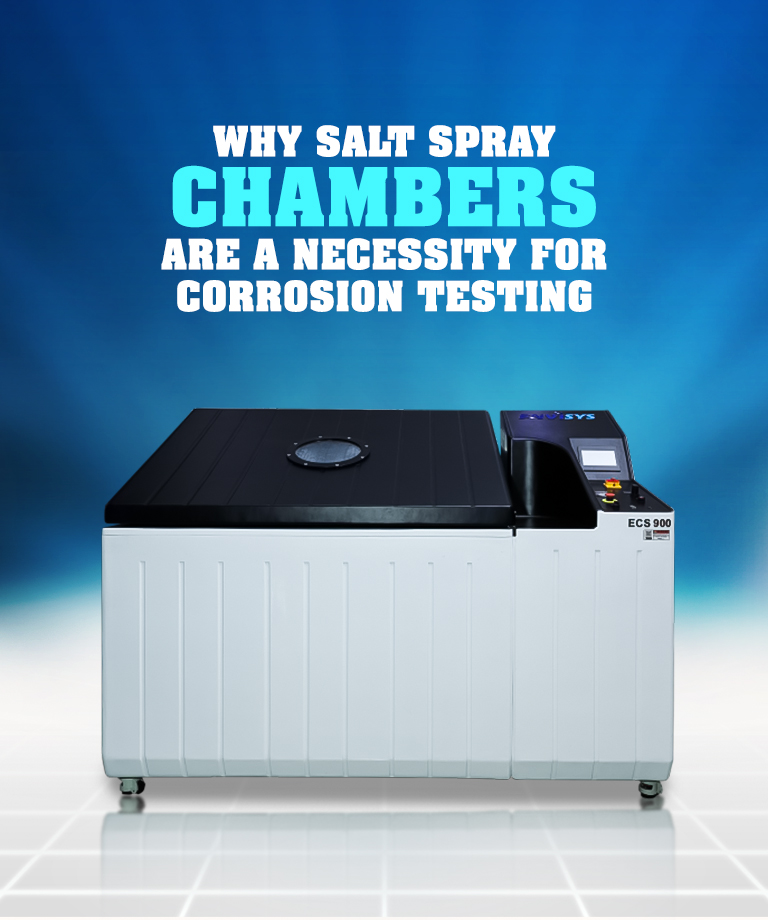
Why Salt Spray Chambers Are a Necessity for Corrosion Testing

Corrosion is the quiet destroyer of industrial machinery, infrastructure, and consumer goods. It’s a billion-dollar pain for industries every year in replacements, repairs, and untimely failures. However, most corrosion damage is completely preventable, if you detect the weakness soon enough. That’s exactly why salt spray chambers have become must-have equipment in quality control labs globally.

What Is a Salt Spray Chamber?

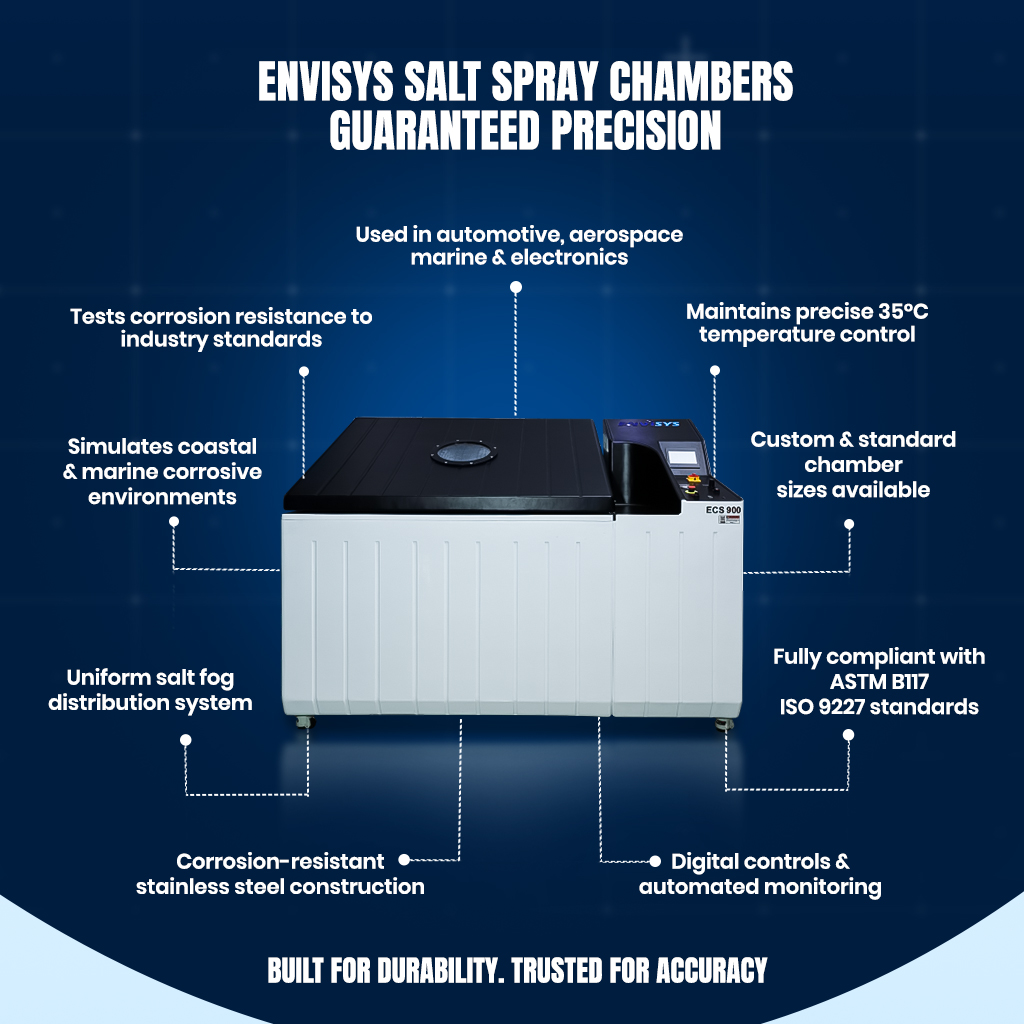
A salt spray chamber, or salt fog chamber, is specialty test equipment used to test the corrosion resistance of materials and coatings. It develops a highly controlled, accelerated corrosive environment by applying a fine aerosolized saltwater solution spray to test specimens, mimicking years of coastal or marine exposure in a matter of days or weeks.

The principle is simple: salt causes corrosion. By subjecting materials to a high concentration of salt fog in a controlled temperature and humidity environment, manufacturers can anticipate how their products will fare in actual corrosive environments. What could take years to see in the field can be replicated in a test chamber in hours.

Contemporary salt spray chambers have several major components that work, a closed testing chamber made of corrosion-resistant materials, a reservoir for the solution, a highly advanced system for atomizing the fine fog, accurate temperature control, and collection systems for the used solution. These components provide a repeatable, standardized test environment that generates consistent, comparable results.

How Salt Spray Chambers Work

The process of testing starts with the solution of saltwater, usually a 5% sodium chloride solution that is similar to seawater. This solution is atomized into a cloud of fine droplets by compressed air and thus forms fog particles that uniformly deposit on test specimens within the chamber.

Temperature is an important factor in the process. Most routine tests are conducted at 35°C, though specifications depend on the test standard being used. The chamber ensures this temperature with accuracy since minor changes can profoundly affect corrosion rates and test integrity.

Test duration is solely determined by the material under test and the specification under which testing is being conducted. Some tests are 24 hours, others weeks. During the course of the test, the specimens are continually immersed in salt fog, preying on any weakness in coatings, finishes, or underlying material.

Once testing is over, samples are withdrawn, cleaned, and inspected. For rust development, coating deterioration, blistering, and depth of penetration, inspectors earch. These observations yield measurable information regarding corrosion resistance that guides material choice, coating refinement, and quality control.

Such as with any measurement instrument, salt spray chambers must be properly maintained to provide consistent, repeatable results. Failure to do so doesn’t only create invalidity for tests it can also cause early equipment failure and expensive downtime.

The interior of the chamber requires maintenance after every test cycle. Salt precipitates build up on internal components and walls as well as spray nozzles. Left untreated, the precipitates change spray patterns, influence humidity distribution, and ultimately destroy the chamber. Cleaning with deionized water takes off salt residue and avoids precipitation buildup.

Spray nozzles need special attention. These tiny parts form the even fog pattern that guarantees uniform test conditions. Defective or worn-out nozzles create uneven spray patterns that compromise test outcomes. Ongoing inspection and replacement of nozzles ensures testing integrity.

Solution reservoir and delivery system require periodic flushing to avoid salt crystallization in lines and valves. Regular calibration of temperature sensors, pressure regulator checks to ensure proper fog generation, and door seals should be intact to avoid fog leakage.

Companies like Envisys Technologies emphasize preventive maintenance as integral to testing reliability. Their chambers are designed with accessibility in mind, making routine maintenance straightforward rather than burdensome. This design philosophy recognizes that a well-maintained chamber provides decades of reliable service.

Critical Applications Across Industries

Salt spray testing has become standard practice across an impressive range of industries, each with distinct concerns but a shared need to understand corrosion resistance.

The automotive industry is dependent almost entirely upon salt spray chambers. Cars are exposed to road salt during winter weather, marine humidity, and industrial emissions. Each body panel to fastener is subject to salt spray testing to guarantee vehicles retain their appearance and structural integrity for the duration of service life.

Aerospace uses require even higher standards. Aircraft fly through water-filled clouds, expose themselves to salt spray at seashore airports, and experience wide temperature fluctuations. Aerospace corrosion is not cosmetic; it is a safety consideration. Salt spray testing ensures that each component remains unaffected by these extremes of conditions.

The marine market has clear requirements. Vessels, offshore structures, and coastal facilities are subjected to continuous exposure to salt. Salt spray chambers assist engineers in choosing the proper materials and protective coatings for given marine conditions. The distinction between a twenty-year-versus-five-year coating system usually becomes evident through accelerated testing well before deployment in the field.

Electronics companies test product enclosures and connectors, construction hardware is tested, even the fasteners that are used to hold solar panels together require corrosion resistance certification, a corroded mounting system can cause panel failure irrespective of the performance of the panel itself.

The Strategic Value of Salt Spray Testing

Spending money on good corrosion testing pays dividends that reach far beyond short-term quality assurance. Spending hundreds of dollars on the time and equipment to do a salt spray test could be compared to warranty claims, field replacements, and reputation damage due to corrosion failures; the return on investment is clear quickly.

Testing also stimulates innovation. When engineers can observe precisely where and how corrosion starts, they can redesign products, optimize coating procedures, or choose improved materials. This self-reinforcing improvement process creates truly better products.

Salt spray chambers are more than test equipment; they’re risk management devices safeguarding investments, confirming design choices, and giving assurance necessary to back long-term warranties. In markets where corrosion is a constant danger, they’re critical infrastructure for creating long-lasting products.


How Industrial Chillers Support Process Temperature Stability

Discussions about industrial chillers are generally centered around cooling capacity, but the competitive edge is really found in something much more fundamental: process temperature stability. Precision isn’t necessarily about staying cold, it’s about achieving thermal equilibrium that has a direct bearing on your bottom line.

The True Cost of Temperature Fluctuations

As process temperatures wander even a little bit from their ideal range, the effects cascade through your whole operation. In injection molding, it takes a 2-3°C variation to produce warping, dimensional variations, and parts that are rejected. Pharmaceutical manufacturers have even stricter tolerances, where temperature volatility within drug formulation jeopardizes molecular structures and makes entire batches worthless. The laser cutting business suffers similarly. Without steady cooling, thermal expansion creates precision errors that total up along the course of production runs.

What such manufacturers often overlook is that these temperature oscillations impose an occult tax on productivity. Aside from the patently evident scrap expenses, fluctuating temperatures compel operators to frequently tune process parameters, increase cycle times for safety factors, and perform extra quality testing. The net result? Lower throughput, higher labour expenses, and compromised competitiveness in markets where speed-to-delivery is critical.

Why Traditional Cooling Systems Fall Short

The problem with traditional cooling methods arises from the fact that they are reactive. Simple chillers react to temperature increases after the fact, introducing an ever-present lag between heat production and cooling action. The reactive cycle creates temperature fluctuations that, although maybe remaining within acceptable limits, never quite reach equilibrium.

Dynamic heat loads are produced by industrial processes. A manufacturing process does not emit a steady heat rate—it varies with production rate, ambient conditions, raw material characteristics, and equipment duty cycles. Without smart thermal management, chillers either overcool during low-demand times or fail to keep up with demand spikes. Either way, energy is wasted and process stability is compromised.

The Engineering Behind True Temperature Stability

Modern industrial chillers from companies such as Envisys Technologies attain stability through a variety of built-in design principles that work in harmony. Excellent scroll compressors deliver smooth, constant refrigeration capacity instead of the on/off cycling which causes temperature fluctuations. Brazed plate heat exchangers optimize thermal transfer efficiency, reacting quickly to load variations with little temperature drift.

True innovation is in sophisticated microprocessor controls that forecast thermal requirements instead of merely responding to them. These systems constantly sense process temperatures, room conditions, and cooling load patterns to make preventive changes. Based on trends measured in milliseconds, they can foretell thermal demands and adjust cooling capacity prior to temperature deviations.

No less vital is the incorporation of primary and secondary pumping systems and bypass valves. Such an arrangement provides steady flow rates through process equipment despite cooling requirements changes, avoiding flow-induced temperature swings that beleaguer more basic systems. CPVC plumbing that resists corrosion means that inside system conditions remain stable throughout years of use, avoiding creeping system performance loss due to scaling or corrosion within.

Various industries require different amounts of thermal accuracy, and knowledge of these needs is important to choose suitable chilling options. In the food and drink industry, having stable 

refrigeration temperatures avoids bacterial growth and retains product quality, but tolerances are fairly wide, usually between 2-3°C ranges.

Compare this to semiconductor production, where wafer processing needs to maintain temperature control to ±0.5°C to avoid microscopic defects. Chemical processing uses has special problems where exothermic reactions produce rapid, high-heat loads. In these situations, chiller capacity and response time can have a direct bearing on both product yield and operator safety.

Medical device production is another extreme, where material properties between molding, curing, or sterilization are influenced by temperature stability. A minor difference in temperature can change the molecular structure of the biocompatible materials, potentially affecting the performance of the device in critical uses.

The Measurable Impact on Process Efficiency

When companies move from simple cooling to precision temperature-control systems, the benefits go far beyond straightforward temperature measurements. Cycle times in manufacturing tend to drop by 8-15% since operators no longer have to make up safety factors for temperature fluctuation. That decrease translates directly into higher production capability with no added capital outlay.

Quality metrics also indicate impressive gains. First-pass yield rates usually increase by 5-10% as defects caused by temperature decline. This benefit accumulates throughout the production process, fewer rejections imply less raw material consumption, lower energy use, and less waste disposal expenses. In high-value products, even a minimal yield increase can result in significant annual savings.

Energy efficiency is another frequently overlooked advantage of temperature stability. Chillers operating within stable temperatures run nearer to their point of ideal efficiency, not expending the energy needed to recover from temperature deviations. Companies commonly report 15-20% decreases in cooling-related energy use subsequent to the installation of precision chilling systems.

Integration with Environmental Testing Ecosystems

For producers who carry out environmental testing and product verification, industrial chillers have a double benefit. In addition to facilitating manufacturing processes, they provide controlled thermal conditioning for test chambers that mimic actual operating conditions. That integration of production and testing environments brings synergies that translate to overall manufacturing quality.

Envisys Technologies, with experience ranging from environmental test chambers to altitude chambers and thermal shock systems, recognizes this integration. Their industrial chillers are designed not as isolated cooling devices but as part of integrated thermal management systems. This integrated perspective guarantees that temperature control spans from early product development to ultimate production verification.

Making the Strategic Choice

Choosing an industrial chiller by cooling capacity alone is the same as choosing a precision CNC machine by spindle power alone is irrelevant. Real process temperature stability involves thinking about system response times, control complexity, component quality, and reliability over the long haul.

Companies that focus on thermal accuracy achieve competitive benefits that reach far beyond short-term production statistics. They realize process stability that allows tighter product tolerances, greater production speeds, and the capability to handle sophisticated materials that require precise thermal conditions. In markets where product excellence and manufacturing efficiency dictate success, temperature stability is not a nicety, it’s a strategic necessity.

The question isn’t whether your operation can afford precise temperature control. It’s whether you can afford the concealed costs of not having it.

What Is a Solar Panel Testing Chamber and Why Is It Important?

Imagine this: your solar panel remains on the rooftop for 25 years, battling blistering summers, freezing winters, deluges of rain, and all that Mother Nature can serve up. How do manufacturers know that these panels won’t suddenly fail after a few years? The key lies in specialized test chambers that subject solar panels to decades worth of abuse within weeks.

The Technology Behind Testing Solar Panels

A solar panel testing chamber is really just a high-tech torture room for photovoltaic modules, but in the best sense of the word. These advanced pieces of equipment produce extreme environmental conditions that simulate what panels may encounter over their full lifetime. It’s like a time machine that accelerates through 25 years of weather in a controlled lab environment.

Within these chambers, temperatures can oscillate from a -40°C bone-freezer to a blistering +85°C, with humidity levels up to 98%. It’s as if exposing panels to Death Valley heat and Antarctic cold all while being extremely precise scientifically.

The Three Pillars of Solar Panel Testing

Thermal Cycling

Thermal cycling tests are probably the most extreme. Panels are quickly cycled and cooled as many as 200 times through dramatic temperatures of 100°C per hour. This harsh treatment determines if solder joints will break, if materials will expand and contract as they should, or if the panel will just quit on thermal stress. It’s like exposing a panel to a lifetime of winter and summer stresses in a matter of weeks.

Damp Heat Testing

During the damp heat test panels are subjected to 1,000 hours at 85°C and 85% humidity, like being trapped in a sauna for more than a month. This test puts panels under stress to see how they respond to moisture invasion, corrosion, and extreme tropical weather.

Humidity Freeze Cycles

This test cycles between freezing temperatures and hot, humid temperatures. It’s meant to mimic those extreme climates where panels would be exposed to morning dew and afternoon sun, then overnight frost, the kind of weather that tries equipment as well as people’s patience.

Why These Tests Matter More Than You Think

This is where things become interesting: these are not merely exercises. Failure of solar panels in the real world can be disastrous, both for the consumers and the environment. A faulty panel does not simply cease to function, it can pose safety risks and invalidate warranties.

Think about it: a normal solar installation runs tens of thousands of rupees and should last 25+ years. Without testing, manufacturers would be taking their huge investments for a ride. Testing chambers wipe out that guesswork by exposing possible issues before panels ever ship from the factory.

The Economics of Quality Assurance

Catching design problems early in the testing of chambers can avoid warranty claims that may cost manufacturers a lot. It’s much less expensive to find out a new adhesive doesn’t work at high temperatures in a test lab than to replace thousands of panels out in the field.

In addition, panels that have survived intense testing are able to command a premium. Companies that pay for extensive testing can stand out in an increasingly competitive market by showing superior reliability through hard facts.

International Standards: The Global Language of Quality

The testing itself adheres to stringent international standards like: IEC 61215, IEC 61730, UL 1703, ASTM E1171. Each standard specifically deals with certain performance and safety parameters of panels. For example, IEC 61215 is the industry standard for crystalline silicon panels, while UL 1703 is required for panels sold in the North American region.

These standards mean that a panel tested in India behaves identically to one tested in Germany or the United States. It’s a world language of quality that allows the global solar trade.

The Technology Evolution

Modern test chambers have become high-tech devices; present-day chambers possess touchscreen interfaces, internet-based monitoring, and AI-driven analytics. Certain chambers are remotely accessible using a smartphone, enabling engineers to observe tests from remote parts of the globe.

Companies such as India’s Envisys Technologies are stretching the limits with chambers that provide accurate control, low-energy operation, and the flexibility to test anything from small residential panels to large commercial modules.

Real-World Impact

The effect is felt not in individual panels but in whole energy systems. Flawed panels destabilise power grids, undermine energy storage systems, and eventually hinder the transition to renewable energy. Test chambers are therefore champions of the transition to renewable energy, guaranteeing that each panel plays its part in our green energy future.

Looking Ahead

As solar technology becomes more sophisticated with bifacial panels, flexible modules, and integrated building products, to name a few, its testing becomes much more sophisticated. Next-generation chambers must replicate new conditions, verify new materials, and keep up with new technologies we can’t yet envision. The stakes continue to escalate as solar’s role in global energy security grows stronger. 

The Bottom Line

Solar panel test chambers may be time-consuming, but they’re absolutely crucial. They sit between bold renewable energy visions and possible disastrous collapse. Each time you notice a solar panel working steadily to supply clean electricity, take it that it probably withstood weeks of tough testing aimed at reproducing decades of actual operating environment.

As the world is accelerating toward clean energy, these chambers guarantee we’re not only going fast we’re also going smart. They’re the behind-the-scenes heroes who will ensure our solar future shines bright and with reliability.

Industrial Chillers: Applications Across Industries & Why They Are Important in 2026

Industrial Chillers Applications

In the world of modern manufacturing and industrial operations, temperature control is no longer optional. It is a critical part of ensuring product quality, process consistency, equipment reliability, and energy efficiency.

One of the most important systems making all this temperature control possible is the industrial chiller.

From pharmaceuticals and plastics to metalworking and food processing, industrial chillers are the central point of improving operational performance. With industries in India progressing with lightning speed under programs such as Make in India and with increasing emphasis on automation and integration with AI, the need for reliable and efficient chilling systems continues to grow with constancy.

What Are Industrial Chillers? 

Industrial chillers are chillers that are used to cool industrial processes and equipment by removing heat, either by air or liquid circulation. They operate by circulating coolant in the form of water or a water-glycol mixture through a closed system for absorbing and releasing heat.

Through maintenance of the machinery, product, and process at optimal temperatures, the chillers avoid overheating, enhance productivity, and save equipment wear and energy expenses.

Why Industrial Chillers Matter More Than Ever in 2025 

The global industrial chiller market is projected to grow at a CAGR of 5.5% through 2030, with India contributing significantly due to its expanding manufacturing base.

In India, there are approximately 35% process industries that utilize chillers for cooling essential components and materials.

Chillers can save energy by 20–30%.

As there are more climate legislations and more requirements for energy-efficient processes, chilling is now a strategic need for industries.

Key Applications of Industrial Chillers in Industries

1) In Plastic & Rubber Industry 

Most of the Industrial chillers have one of the most frequent applications in plastic injection molding, extrusion, and blow molding. Chillers helping rapid quenching of plastic molds. Also assures material uniformity, thus reduces cycle times, improves productivity. 

2) In the Pharmaceutical Industry 

Temperature accuracy is critical in pharma, especially in Chemical formulation, the Biotech processes (e.g., fermentation) or be it the Storage of temperature-sensitive ingredients. Even the 

Preservation of cleanroom environments is a must. 

Chillers offer regulatory compliance (GMP requirements) and support batch consistency.

3) In the Food & Beverage Industry 

Cleanliness and freshness are of utmost importance in food and beverage processing industry. Primarily, the Chillers are used to Cool ingredients during blending and processing. Control brewery and dairies’ fermentation temperatures,Provide stable cold chain storage conditions. Chillers today use food-grade materials and anti-bacterial build to fulfill industry requirements. 

4) In Metalworking & Machine Tools

From CNC machines to welding systems, metal fabrication operations cause high heat generation. 

Chillers play a critical role in Tool and spindle cooling.Control of lubricant and hydraulic oil temperatures and Preventing thermal distortion. Improving tool life and machine uptime 

5) In Chemical & Petrochemical Industry 

The chemical industry entails sophisticated reactions that tend to demand specialized temperature control. Chillers here: 

Stabilize reaction vessels 

Assist in distillation and crystallization 

Ensure safety through prevention of overheating or thermal runaway The systems tend to demand explosion-proof chillers and corrosive-resistant materials.

Indian Chiller Demand Growth 

The increasing adoption of energy-efficient solutions has driven up demand for industrial chillers in India. Some of the key factors are:

Development of pharma and biotech clusters in Hyderabad, Ahmedabad, and Pune Increasing plastic production zones in Gujarat and Tamil Nadu

Investing in smart factories and Industry 4.0 programs

The increasing energy efficiency requirements from the Bureau of Energy Efficiency (BEE)

West and North Indian industries, especially those in Maharashtra, Gujarat, Delhi NCR, and Punjab, are key contributors to the increasing demand.

Selecting the Right Industrial Chiller 

The right chiller is chosen based on:

Cooling capacity needs (tons or kW)

Industry or process type

Ambient environmental conditions

Air-cooled versus water-cooled design

Energy efficiency and operational expense

Availability of space and noise tolerance

Team up with the appropriate chiller vendor to ensure the system is custom-designed to fit your application and provide long-term performance reliability.

Conclusion: Industrial Cooling is a Competitive Advantage 

Industrial chillers in 2025 and beyond are not auxiliary equipment; they’re tactical assets. With an effective process, quicker production cycles, improved quality control, lower downtime, and reduced energy expense are the benefits one gets. As industries are consistently growing and incorporating more sophisticated technologies, an efficiently designed cooling system is essential to remain competitive.

Require an Industrial Chiller Customized to Your Industry? 

Envisys Technologies is an expert in designing industrial chillers for various industrial applications. From smaller units to large-capacity chillers, our offerings are relied on by India’s top manufacturers. Contact us today to talk about your cooling needs and find out how our chillers can make a difference to your operations.

give us a shout

Are you Ready to have a Talk?

Whatsapp Icon